
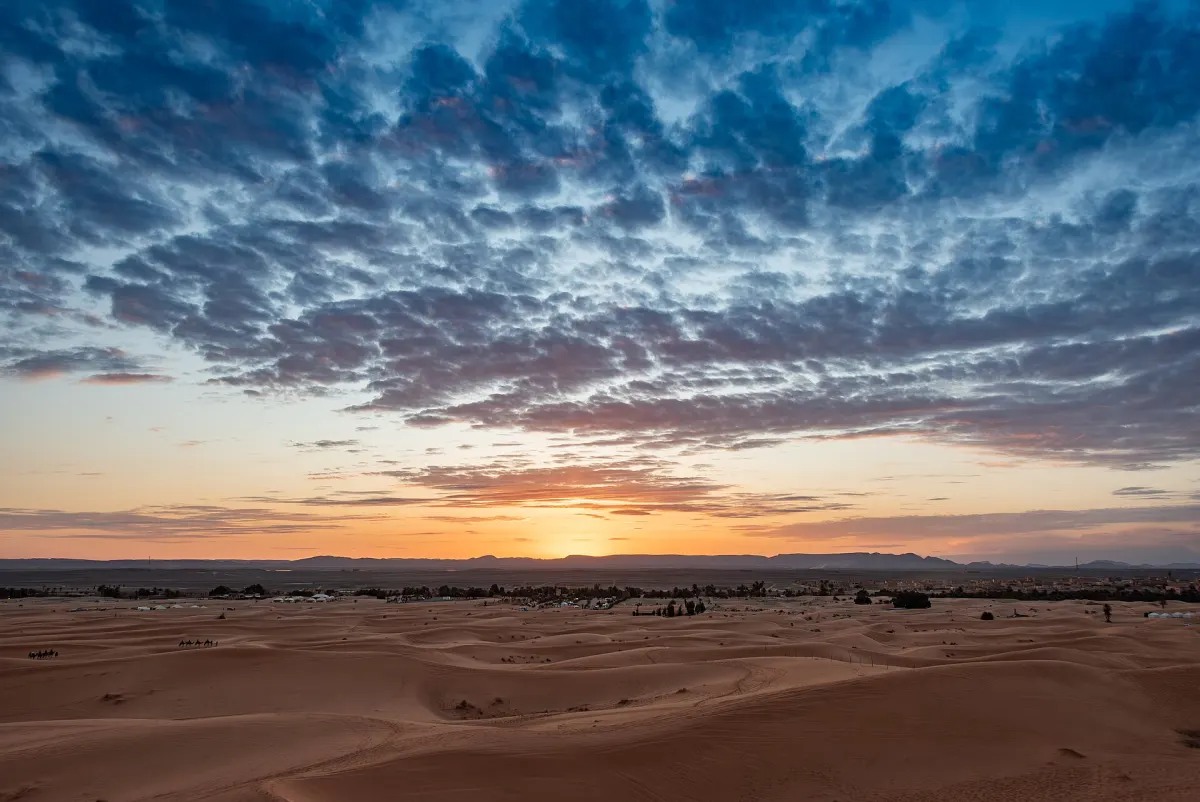
Merzouga is one village, one road, and one field of sand 28 km long. Everything else you were promised — the Gnaoua village, the fossil workshops, the old caravan town — lies around that sand, 8 to 60 km away, on no bus route.
Getting there is the trip
Three ways in, and they are not interchangeable.
From Marrakech it is the N9 over the Tizi n’Tichka — at 2,260 m the highest point on the country’s main road network — to Ouarzazate, 200 km and four hours. Then the N10 east through Skoura, Kelaat M’Gouna, Tinghir and Tinejdad, and the N13 south via Erfoud and Rissani to Merzouga. About 570 km and nine hours: a two-day drive, sleeping in Ouarzazate.
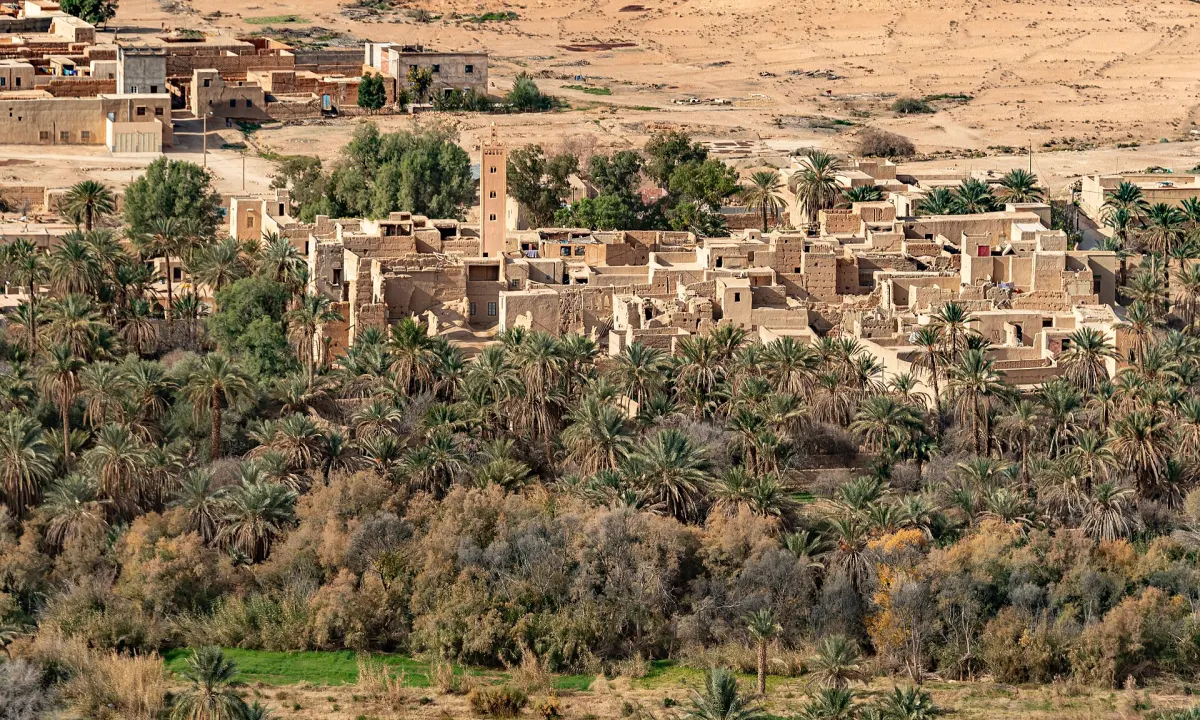
From Fes it is the N13 the whole way south — Azrou and its cedar forest, Midelt, Errachidia, then down the Ziz valley to Erfoud and Rissani. About 470 km and seven and a half hours, almost all mountain and gorge. The Ziz is the reward: a canyon floored with palm groves and flat-roofed ksour, the road on its rim.
Flying to Errachidia is the fast version. Moulay Ali Cherif airport (ERH) is 130 km and about two hours north of Merzouga by the N13, with rental desks in the terminal. Royal Air Maroc flies it from Casablanca three to five times a week in about seventy minutes, and that thin schedule is the catch: no flight means no arrival, and the alternative is the drive you were trying to avoid.
| Departure point | Road | Distance | Drive time |
|---|---|---|---|
| Marrakech | N9 (Tizi n’Tichka) → N10 → N13 | ~570 km | ~9h, two days |
| Ouarzazate (the natural overnight stop) | N10 → N13 | ~370 km | ~5h |
| Fes | N13 (Middle Atlas, Ziz valley) | ~470 km | ~7h30 |
| Errachidia airport (ERH) | N13 via Erfoud and Rissani | ~130 km | ~2h |
Why you want your own car here
The erg is the centre of the trip and the reason you cannot see the rest of it. What rings it:
- Khamlia, 8 km south: a Gnaoua village of descendants of sub-Saharan Africa, whose families have played this music in the same courtyards for generations. The concerts happen after dark, in people’s houses. No bus back.
- Dayet Srji, two to four kilometres out on the Rissani road past Hassi Labied: a shallow seasonal basin that fills after rain and pulls in flamingos when it does. In a dry year it is cracked mud — nothing tells you in advance which year you have arrived in, so you go and look. This is the one exception to everything above: at that distance the lake is a walk, and it would be dishonest to sell it to you as a reason to rent a car.
- Rissani, 35 km west: the region’s real town and its biggest market, three mornings a week, with a livestock section worth the drive alone. Five kilometres outside stand the ruins of Sijilmasa, the medieval caravan city at the northern end of the gold road to Timbuktu.
- The fossil workshops between Rissani and Erfoud: this is Ordovician and Devonian seabed, and the workshops cut and polish orthoceras and trilobites dug a few kilometres away. You can watch one freed from its slab and buy it for a fraction of the Marrakech price.
- M’Fis, 35-40 km south, an abandoned mine village on the far side of the erg, and Tissardmine on the southern rim: half a day each, on sand and rock, with no tarmac after the turnoff.
None of that is organised: no bus worth the name, and a grand taxi will take you to Khamlia or Rissani only if you pay for the return and the waiting. Your own car turns five negotiations into one afternoon.
Sedan or 4x4?
Every road in the table is paved, and a small saloon does all of it. If the trip is the drive down, a night or two in a camp and the drive back, a 4x4 is money spent on nothing: ground clearance matters more than four-wheel drive here, and a diesel saloon with a 1.5-litre engine is the right car for the Tichka and the Ziz.
What changes the answer is the last few kilometres. Camps sit at every depth: some in Hassi Labied, where the tarmac ends at their gate; some three to ten kilometres out between the dunes, which no two-wheel-drive car reaches; a few deep enough in the sand that they drive guests in and out themselves. The graded tracks to Khamlia and along the erg’s western edge are fine in a saloon when dry, but are crossed by sandy wadis after rain. The circuit’s southern half, toward M’Fis and Tissardmine, wants a 4x4 or somebody else’s.
Two questions to ask before you book:
- “Can an ordinary car reach the camp, or do you collect guests?” If they collect you, a 4x4 is only worth it for going looking for M’Fis yourself.
- “Is the transfer included both ways?” Some camps quote a camel ride in and charge for the vehicle out, or the reverse.
If you want a 4x4 for the M’Fis track, rent it in Marrakech or Fes rather than at Errachidia, where the fleet is small and mostly saloons. And note what a 4x4 does not buy you: permission to drive on the dunes.
Parking at the sand’s edge
Two villages sit at the edge of the erg, both on tarmac: Merzouga, and Hassi Labied five kilometres north, where most camps keep their offices and the road comes closest to the sand.
In Merzouga everything is on the one main street — agencies, cafés, guesthouses — with parking along the roadside and in a few walled lots behind the buildings; Hassi Labied is the same at half the scale. Sleeping in the sand, you park with the camp: they have a lot, or an arrangement with a guardian, and it is included. If not, a guarded lot runs 20-40 MAD a night.
You will be approached as you slow down. Merzouga has a persistent fringe of men offering parking, guiding and “the best camp”; the ones working through the agencies do not flag you down in the street. Decide where the car is going before you arrive, take the guardian’s ticket, photograph the vehicle and leave nothing visible inside. Do not hand over your keys: a lot that wants them so it can shuffle cars is a lot to drive past.
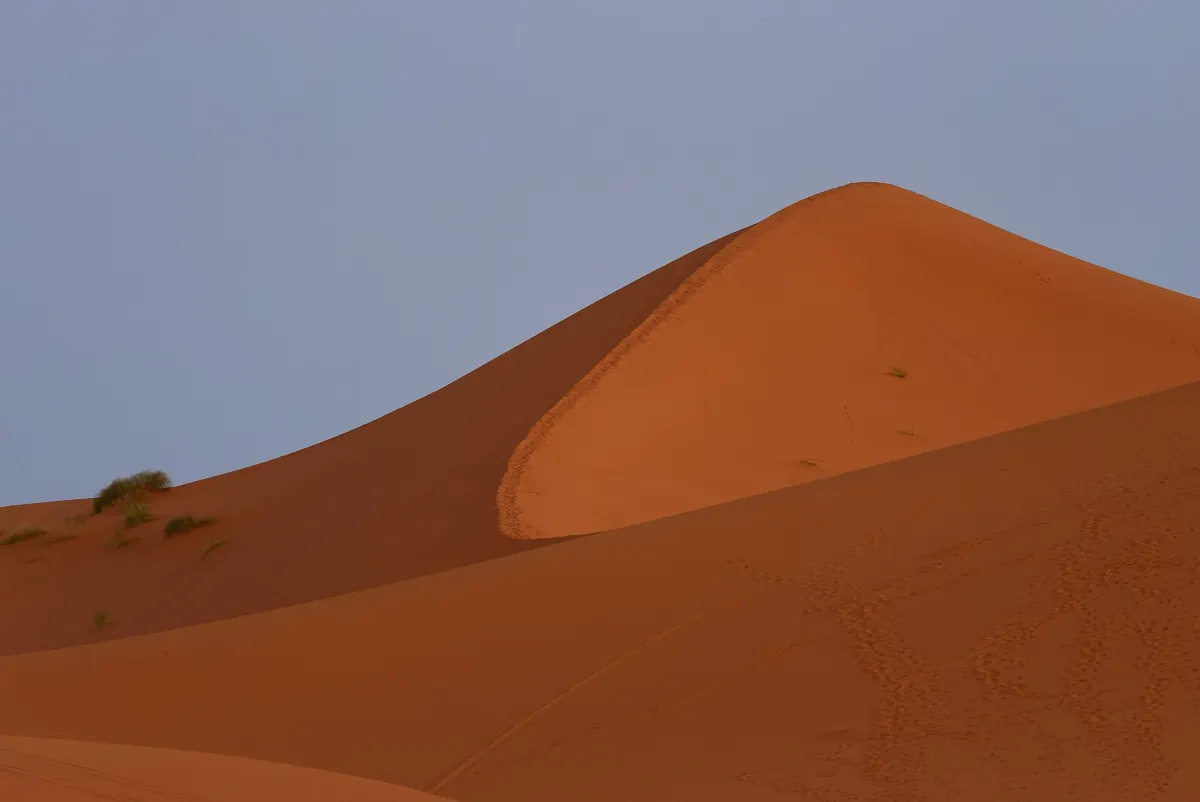
Then the rule that matters more than the rest: do not take a rental car into the sand. Not onto the dunes at the edge of the village, not “just far enough for the photograph”. A saloon sinks to the chassis within a few metres; a 4x4 gets further and digs in harder. Recovery here is a cash negotiation with whoever owns a truck, so assume the sand is not covered. The tracks you can see are mostly the camps’ own vehicles.
The camp handover
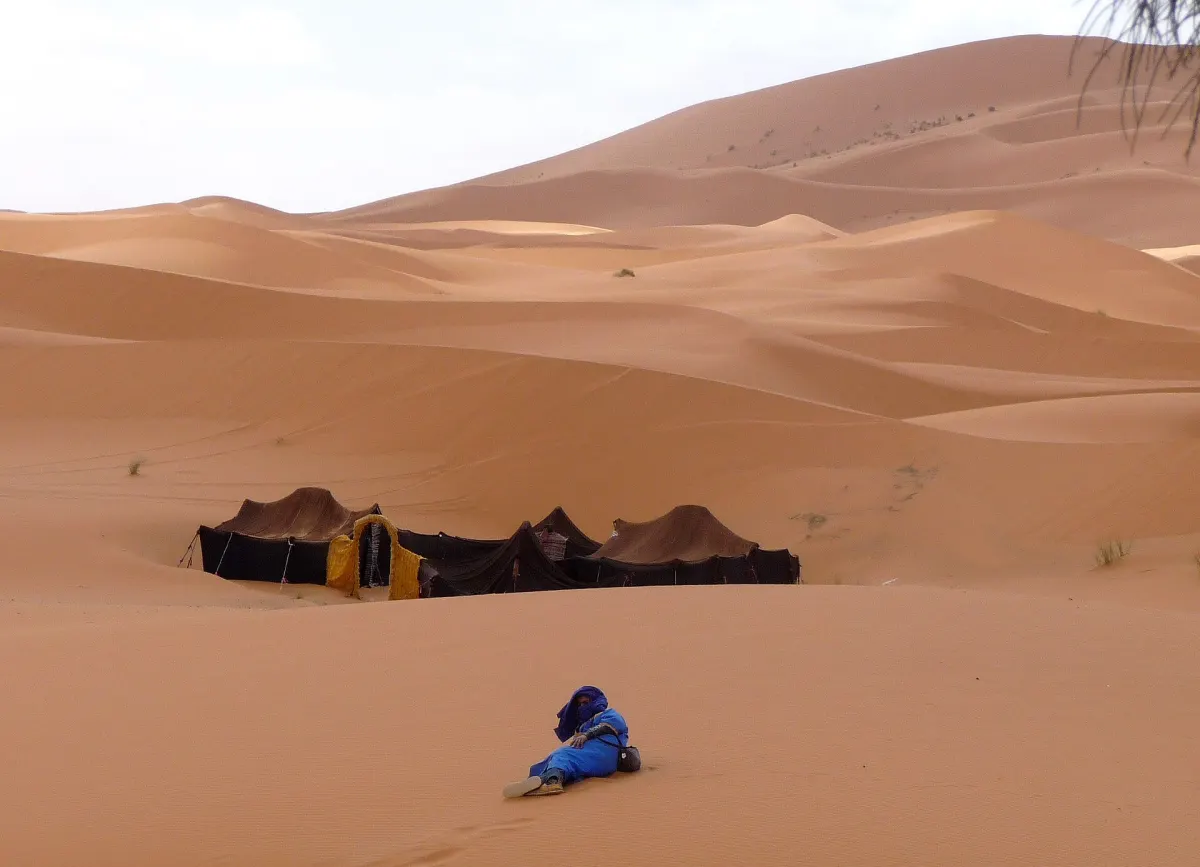
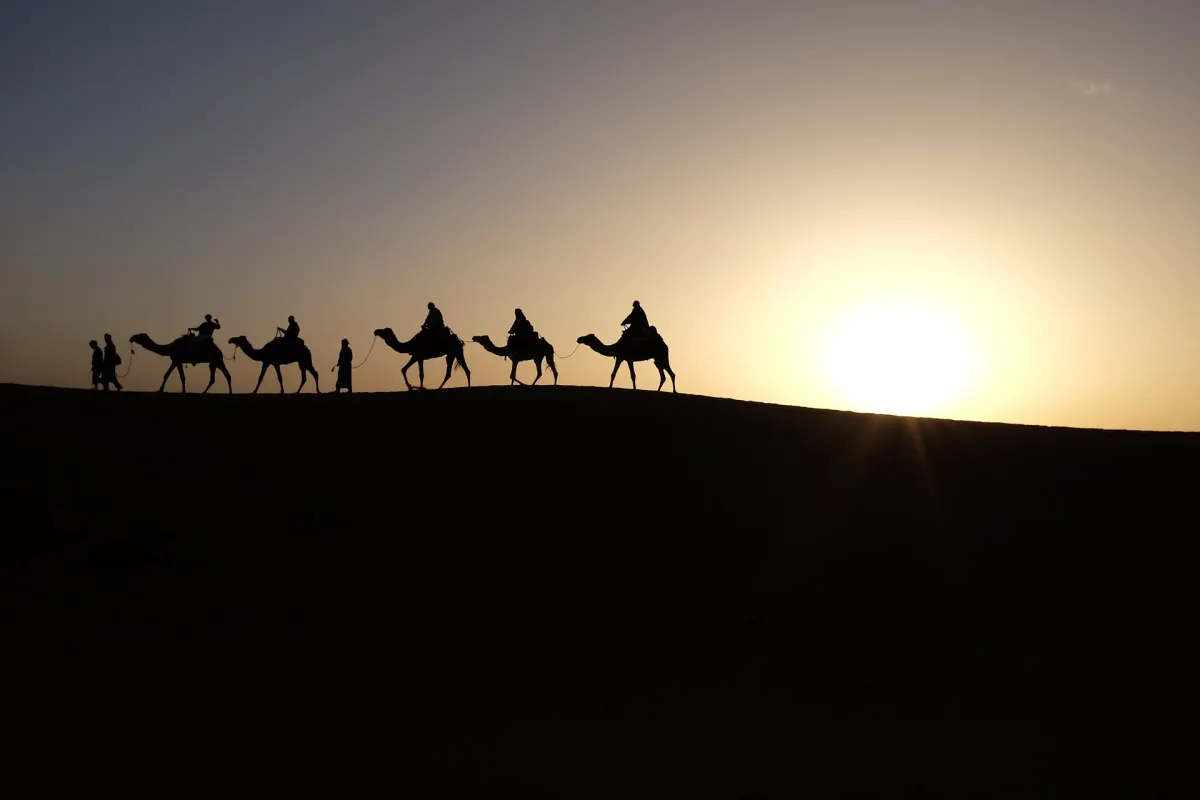
The car stays where you left it. The camp collects you, by camel — an hour to ninety minutes, in a line with a guide leading — or by 4x4, which takes fifteen to twenty minutes. Some camps do camel in and vehicle out, some the reverse, some decide on the day.
Included as standard: the transfer both ways, dinner, breakfast, tea on arrival and bedding. The price band is wide — 300 to 1,500 MAD a person with dinner and breakfast — the difference being a shared tent with shared bathrooms at one end and a private tent with a real bed and a hot shower at the other.
Before you pay, settle:
- The transfer both ways, by camel or vehicle, and whether either leg costs extra.
- The departure time in the morning. A camp that leaves at 05:30 for sunrise is different from one that leaves at 09:00, and this is what people forget to ask.
- What dinner and breakfast actually are, and whether water and soft drinks are included — they usually are not.
- Whether the camel ride is part of the price or charged per person on top.
- How the balance is paid. Most camps take a deposit through a booking platform and want the rest in cash on arrival.
Two practical notes. Mobile coverage inside the erg is patchy to absent, so settle the morning’s plan in person the night before rather than by phone from the tent. And pack as if the transfer were a hike: leave the suitcase in the car and take one soft bag.
Sunrise, sunset and the season
Light is the point of the place, and it is short. In mid-September the sun rises at Merzouga around 07:00 and sets around 19:25. Note the change: Morocco has kept UTC+1 year-round except during Ramadan, and on 20 September 2026 it moves to UTC+0, where it stays — so from 20 September sunrise is about 06:03 and sunset about 18:16, an hour earlier than any guide printed before the change will tell you. By late October it is 06:26 and 17:34; in December, 07:12 and 17:20; in June, 05:12 and 19:21.
Dawn is the one worth the alarm. Sunset at the erg is beautiful and busy: every camp’s vehicles converge on the same handful of viewpoints, and by evening the sand in front of them has been tracked all day. At dawn you walk up from the camp in the dark, twenty to thirty minutes to the nearest high ridge, and have the dune face to yourself until the light arrives.
The months to avoid are July and August. Days run 40-45°C, the sand surface is far hotter than the air above it, and a parked car becomes an oven while you are in it; the camps are cheap and half-empty for that reason. October, November, March and April are the best of it — 25-30°C in the day, nights that need a jacket. December and January give clear days around 18°C and cold nights, because Merzouga sits just under 800 m. In late winter and spring the chergui, the hot easterly wind, sometimes turns the air to sand for an afternoon.
The thing to check before you set off is rain rather than heat: Merzouga gets very little, but when it comes it comes hard, and the road from Rissani is the first casualty.
What the drive costs
Fuel is around 15 MAD a litre: about 14.95 for petrol and about 15.04 for diesel, with diesel the dearer of the two. The Marrakech loop is 570 km out and 570 back, plus 150-250 km between the villages, the lake, Rissani and the camps — call it 1,300-1,400 km. A small diesel at 6 L/100 km burns about 80 litres, so 1,150-1,200 MAD; a petrol saloon at 7.5 L/100 km burns about 100, so around 1,500 MAD. Budget 1,200-1,500 MAD for fuel.
Tolls on this route: none. The N9, the N10 and the N13 are national roads; there is no autoroute between Marrakech and the dunes. Whatever you paid in tolls, you paid to get to Marrakech.
Indicative budget for two people, four nights, from Marrakech:
| Item | Cost |
|---|---|
| Fuel, the loop and local driving | 1,200-1,500 MAD |
| Tolls | 0 MAD |
| Guarded parking at Merzouga or Hassi Labied | 20-40 MAD a night |
| Two nights in a camp, dinner and breakfast included | 600-3,000 MAD for two |
| Camel transfer, if it is not included in the camp | 150-300 MAD a person |
| Two nights en route, Ouarzazate or the Todra area | 400-800 MAD for two |
That puts the trip at roughly 2,300-6,000 MAD before the car: about 2,300 if the camel is included and you sleep simply, 6,000 at the top of every range at once. Fill up in Erfoud or Rissani rather than counting on the pump in Merzouga, and carry cash — those two towns are the last with several banks.
Practical notes
Coverage. Maroc Telecom has the best rural signal here; a tourist SIM at the airport is about 100 MAD for 20 GB. Merzouga and the villages have 4G, but the erg, the M’Fis track and the Midelt–Errachidia stretch have gaps big enough to matter, so download offline maps before you leave.
Cash. No card readers in the camps, the workshops, the souk or with any parking guardian. Keep 1,000-1,500 MAD in 50s and 100s. Erfoud and Rissani have the reliable ATMs; Merzouga’s are few and can be empty.
Water. Four to five litres a person a day from April to October, bought in Erfoud or Rissani: the camps provide some, but not enough, and mint tea is not hydration.
If something breaks. There is no recovery service on the pistes and no garage in Merzouga. The nearest workshops are Rissani, 35 km away, and Erfoud, 60 km, and getting the car to one is a cash negotiation with whoever owns a truck. Know your roadside number and your insurance excess before you set off, and do not drive at night — the roads are unlit, so are the donkeys and mopeds.
Merzouga without a car is a compromise: you reach the dunes and miss everything arranged around them. With one, the erg becomes the middle of the trip rather than the whole of it. IVVER lists cars from professional providers, so the vehicle is one decision you make before you fly rather than an argument in a car park 570 km away.
Photographs: Erg Chebbi sunset by Jorge Franganillo, CC BY 2.0; Berber camp at Merzouga by gailhampshire from Cradley, Malvern, U.K, CC BY 2.0; Ziz valley by Jorge Franganillo, CC BY 2.0. The dune ridge and camel caravan photographs are CC0 and require no credit. The register of all image credits, with the Commons title and source page for each: /blog-media/CREDITS.md.